Healthy eating advice is everywhere, and a lot of it is loud. One day eggs are bad, the next day they are great. Carbs are the enemy, then fat is the enemy. If you are a busy mom, you do not have time to untangle all that. You just want to know what to put on the table tonight.
⚡ The short answer
Healthy eating comes down to a few simple habits, repeated. Eat mostly whole, minimally processed foods. Fill your plate with fruits and vegetables. Choose whole grains. Cut back on added sugar and highly processed snacks. Plan a little. Do not aim for perfect.
This guide has 14 tips, a week-long plan, easy swaps, common mistakes with fixes and a checklist.
This is general nutrition information, not medical advice. If you have a health condition, a food allergy or you are pregnant or breastfeeding, talk with your doctor or a registered dietitian before making big changes. 🥕
You do not have to try all 14 tips at once. In fact, please do not. Pick one or two that feel easy and start there. Habits stick when they are small.
What Does “Healthy Eating” Really Mean?
Healthy eating is not a diet. It is a way of eating most days that gives your body what it needs and leaves room for joy. Nutrition experts tend to agree on a few broad ideas, even while they argue about the details:
- Eat plenty of fruits and vegetables. They add fiber, vitamins and color.
- Choose whole grains most of the time. Harvard’s Nutrition Source explains that whole grains keep the bran, germ and endosperm, while refined grains remove parts of the grain.
- Get protein from a mix of foods. Beans, eggs, fish, poultry, dairy, nuts and seeds all count.
- Limit added sugar. The CDC says no amount of added sugars is recommended as part of a healthy diet.
- Go easy on highly processed foods. Harvard’s analysis of the 2025–2030 Dietary Guidelines for Americans says the new guidance specifically points away from highly processed foods such as sugary drinks and packaged salty or sweet snacks.
💡 Progress, not perfection
A “good enough” week of meals beats a perfect plan that falls apart by Wednesday. Aim for most meals, most of the time.
14 Healthy Eating Tips for Real Life
Tip 1: Start with one small change
Choose one habit. Maybe it is adding a vegetable to dinner. Maybe it is swapping soda for sparkling water. Practice it for two weeks before adding another. Small changes build confidence.
Tip 2: Fill half your plate with fruits and vegetables
This is a common rule of thumb that makes dinner easier to plan. Start with the veggie, then add a protein and a grain. Frozen and canned vegetables work too. Look for versions without a lot of added salt or sugar, and rinse canned beans and vegetables if you want to cut some of the salt.
Tip 3: Choose whole grains most of the time
Look at the ingredient list. If the first ingredient says “whole wheat,” “whole oats” or “brown rice,” that is a good sign. Simple swaps include brown rice instead of white, whole-wheat pasta instead of regular, and rolled oats instead of sugary cereal. Harvard’s Nutrition Source has more about what counts as a whole grain.
Tip 4: Cut back on added sugar
The CDC says no amount of added sugars is recommended as part of a healthy diet. Harvard’s analysis of the 2025–2030 Dietary Guidelines says they also set a limit of no more than 10 grams of added sugars in a meal. Sugar hides in sauces, yogurts, cereals, granola bars and drinks, so reading labels helps. The American Heart Association has a helpful guide to spotting added sugars on a label.
Tip 5: Drink more water
Water is the simplest drink for most people. If plain water bores you, add a slice of lemon or a few berries. Keep a bottle where you can see it. Sugary drinks are one of the easiest places to cut sugar.
Tip 6: Plan three dinners, not seven
Seven planned dinners can feel like a lot. Plan three, and let the other nights be leftovers, breakfast-for-dinner or a simple “snack plate.” This takes the pressure off and cuts food waste.
Tip 7: Cook once, eat twice
Make a big pot of soup, a pan of roasted vegetables or a batch of rice. Use it for two meals. Cooking in batches saves time and money. Follow food safety rules: the USDA says most leftovers are safe for three to four days in the fridge, or you can freeze them.
Tip 8: Read the front and back of the package
The front of a package is advertising. The back has the facts. Check the ingredient list and the Nutrition Facts label. The FDA has updated the rules for when a food label can use the word “healthy,” so it is worth knowing that a claim on the front is not a replacement for reading the label.
Tip 9: Build snacks from real food
Fruit, cheese, yogurt, nuts (for kids old enough to eat them safely), hummus and veggies, whole-grain crackers and popcorn (for older kids) make better snacks than many packaged options. Set out a snack plate rather than letting kids graze all afternoon.
Tip 10: Keep a “fast and healthy” list
On the busiest nights you will want something quick. Make a short list now: scrambled eggs and toast, bean and cheese quesadillas, pasta with frozen vegetables, a sheet-pan dinner. Tape it inside a cupboard.
Tip 11: Eat slowly and pay attention
Eating fast makes it easier to eat past fullness. Put the fork down between bites. Chat. Turn off screens at the table when you can. This is good for adults and kids alike.
Tip 12: Involve your kids
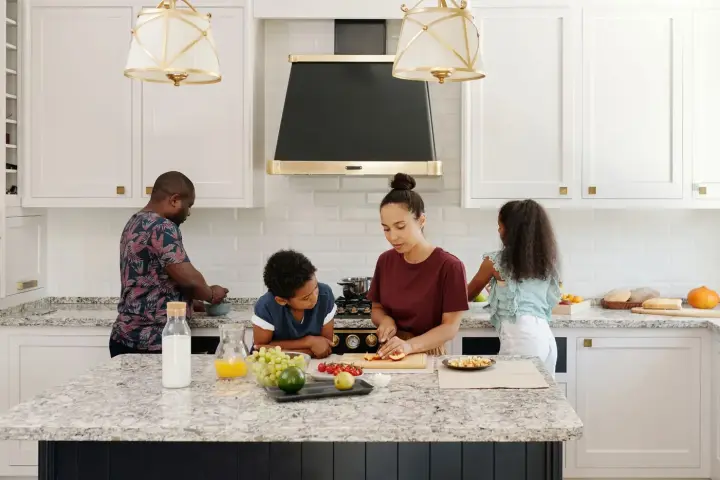
Kids are more likely to try foods they helped wash, stir or pick out. Give them small jobs, such as tearing lettuce, mixing batter or choosing a new vegetable at the store. Do not pressure them to eat. The CDC and the American Academy of Pediatrics both suggest offering new foods many times in a relaxed way.
Tip 13: Stock your kitchen for success
You eat what is easy to reach. Put fruit in a bowl on the counter. Keep cut vegetables at eye level in the fridge. Store cookies and chips in a higher cupboard. This simple change helps all family members.
Tip 14: Be kind to yourself
Everyone has a takeout night, a birthday cake or a rushed breakfast. Do not let one meal derail your week. Shame does not help. Getting back to your usual habits at the next meal does.
| Instead of | Try | Why it helps |
|---|---|---|
| Sugary cereal | Plain whole-grain cereal with fruit | Less added sugar and more fiber |
| Flavored yogurt | Plain yogurt with berries | You control the sugar |
| White bread | Whole-wheat bread | Keeps the bran and germ |
| Soda or juice drinks | Water, sparkling water or milk | Cuts added sugar |
| Chips | Popcorn or whole-grain crackers | Whole grain and often less processed |
| Store-bought dressing | Olive oil and lemon or vinegar | Fewer additives and sugar |
| Candy as a reward | A sticker, a game or extra playtime | Keeps food neutral |
What to take from the table: none of these swaps are hard, and none require special skills. Pick one that fits your family and try it for a week.
⚠️ Be careful with strict rules for kids
Children are growing, and their needs differ from adults. Do not put a child on a restrictive diet or talk about “bad” foods or weight without talking to your pediatrician first. Focus on offering a variety of foods and a calm table.
Healthy Eating on a Budget
Eating well does not have to cost a lot. Many of the most useful foods are among the cheapest.
- Buy beans, lentils and oats. They are filling, shelf-stable and low in cost.
- Use frozen fruit and vegetables. They keep for months and you only use what you need.
- Cook in batches. A big pot of soup or chili feeds the family for days and freezes well.
- Plan around sales. Look at weekly flyers and build a meal around what is cheap.
- Cut food waste. Use wilting vegetables in soups, fried rice or smoothies.
- Skip single-serve packages. Buying a big bag of oats or a tub of plain yogurt and portioning it at home usually costs less.
- Choose store brands. For plain staples such as flour, oats and canned beans, store brands are often a good choice.
- Make your own mixes. Plain oatmeal with fruit costs less than instant packets, and you control the sugar.
📌 Note on prices
Prices change by store and by month, so we do not list any here. Compare unit prices on the shelf tag (cost per ounce) to find the best deal.
Understanding Portions Without Counting
You do not need a scale to eat well. A few easy habits help.
- Use smaller plates and bowls. This helps you serve a reasonable amount without feeling deprived.
- Serve at the stove. Putting serving dishes on the table can encourage seconds. Serving plates in the kitchen makes seconds a choice.
- Check in halfway. Pause and ask whether you are still hungry.
- Respect kids’ hunger cues. Let children stop when they say they are full, and let them ask for more when they are still hungry.
- Start small. It is easier to add a spoonful than to remove food from a plate.
Portion advice for individuals varies a lot with age, size, activity and health. If you want personal numbers, ask a registered dietitian.
A Realistic Week of Healthy Dinners
Here is a plan that does not require much cooking. It uses leftovers, one-pan meals and a “no-cook” night.
| Day | Dinner | Notes |
|---|---|---|
| Monday | Sheet-pan chicken and vegetables | Cook extra for tomorrow |
| Tuesday | Chicken and bean quesadillas with salad | Uses Monday’s leftovers |
| Wednesday | Pasta with frozen vegetables and cheese | Fast and kid-friendly |
| Thursday | Big pot of vegetable and bean soup | Make extra and freeze half |
| Friday | Breakfast for dinner: eggs, whole-grain toast and fruit | Easy cleanup |
| Saturday | Family pizza night with whole-wheat crust and veggies | Let kids add toppings |
| Sunday | Soup leftovers and a simple salad | Rest day |
What to take from the table: five of seven nights are quick or use leftovers. You can use the Living Healthy Mom meal planner to save your plan and make a grocery list.
You are not trying to cook like a chef. You are trying to feed people you love, most days, in a way that works.
Kitchen Tools That Make Healthy Eating Easier
These are examples that might help with meal prep, portions and packing lunches. We have not tested them for this article. The details come from the Amazon listings (checked October 4, 2026), and listings can change.
Pick 1 · Glass containers for leftovers and meal prep
Pyrex Simply Store Glass Food Storage Set (9 containers, 18 pieces)
May suit: Households that want to store and reheat leftovers in glass instead of plastic.
A good starter set for leftovers and meal prep. Why it works: glass containers can go from the fridge to the microwave without a transfer. Best for: families trying to use less plastic. Problem it solves: stained, smelly plastic tubs.
- Mixed sizes: includes a 7-cup round, a 6-cup rectangle and several smaller containers
- Tempered glass that the listing says resists stains and odors
- Listing says the plastic lids are BPA-free
- Listing says lids are freezer, microwave and top-rack dishwasher safe
- Set
- 9 containers with lids (18 pieces)
- Container material
- Tempered glass (per listing)
- Lids
- BPA-free plastic (per listing)
- Care
- Lids: freezer, microwave and top-rack dishwasher safe (per listing)
- Brand
- Pyrex
Strengths
- Glass does not stain or hold smells
- Many sizes in one set
- Nested storage saves cupboard space
Limitations
- Lids are still plastic, so replace them if they warp or crack
- Glass is heavier than plastic and can break if dropped
Affiliate link. As an Amazon Associate, we earn from qualifying purchases.
Pick 2 · Jars for overnight oats, salads and snacks
Ball Wide Mouth 16 oz Glass Mason Jars with Lids and Bands (12 pack)
May suit: Families who like make-ahead breakfasts, overnight oats, yogurt parfaits and glass storage.
A simple way to make grab-and-go breakfasts. Why it works: a wide mouth and a tight lid make make-ahead jars easy. Best for: overnight oats, chia pudding and yogurt cups. Problem it solves: busy mornings with nothing ready.
- Wide-mouth glass jars, 16 ounces each
- Listing says food-grade glass and BPA free
- Lids and bands included
- Listing describes airtight, leakproof lids
- Count
- 12 jars with lids and bands
- Size
- 16 fl oz each
- Material
- Glass (per listing)
- Material features
- BPA free, food grade, heat resistant (per listing)
- Brand
- Ball
Strengths
- Wide mouth makes filling and cleaning easier
- Glass does not hold onto smells or stains
- Good size for a single serving of oats or yogurt
Limitations
- Glass is heavier and can break if dropped
- Check the brand's instructions before microwaving or freezing
Affiliate link. As an Amazon Associate, we earn from qualifying purchases.
Pick 3 · An insulated water bottle to make drinking water easy
Hydro Flask Standard Mouth Insulated Stainless Steel Water Bottle (21 oz)
May suit: Anyone who drinks more water when it is cold and easy to carry, from school kids to parents on the go.
A sturdy bottle to make water the easy choice. Why it works: cold, great-tasting water is easier to reach for than a sugary drink. Best for: school bags, car cupholders and desks. Problem it solves: relying on juice or soda when you are thirsty.
- Insulated stainless steel; listing says 24 hours cold and 12 hours hot
- Leakproof Flex Cap (per listing)
- Fits most cupholders (per listing)
- Dishwasher safe, with pro-grade stainless steel that listing says avoids flavor transfer
- Size
- 21 oz
- Material
- Stainless steel (per listing)
- Keeps drinks
- Cold for 24 hours, hot for 12 hours (per listing)
- Lid
- Leakproof Flex Cap (per listing)
- Care
- Dishwasher safe (per listing)
- Brand
- Hydro Flask
Strengths
- Cold water stays cold, which helps some people drink more
- Stainless steel is durable
- Fits cup holders
Limitations
- Costs more than a basic plastic bottle
- Insulated bottles are heavier than empty plastic ones
Affiliate link. As an Amazon Associate, we earn from qualifying purchases.
Healthy Eating for Busy Moms: A Short Starter Routine
If you want a simple routine, here is one that takes about 30 minutes on a weekend:
- Pick the plan. Choose three dinners and one breakfast to repeat this week.
- Make a list. Write down what you need and check your pantry before you shop.
- Shop once. One trip saves time and reduces impulse buys.
- Wash and chop. Wash fruit and cut a few vegetables so they are ready to grab.
- Cook one batch. Make rice, roasted veggies or a pot of soup for two meals.
- Pack snacks. Put fruit, cheese or crackers in small containers for easy reach.
Why this works: a little time on the weekend means fewer last-minute choices on weekdays, and that makes healthy eating the easy option.
Tips for Kids and Picky Eaters
Healthy eating with children works best when it is relaxed.
- You decide what and when. Your child decides how much. This idea is often called the division of responsibility. It takes pressure off both of you.
- Offer new foods many times. It can take many tries before a child accepts something.
- Pair new foods with familiar ones. Put a single bite of broccoli next to the pasta they love.
- Avoid bribes and “clean plate” rules. They can make food feel like a battle.
- Serve small portions. You can always offer more.
- Keep the table calm. A pleasant mealtime teaches more than any lecture.
- Check for allergies and choking hazards. If you are unsure what is safe for your child’s age, ask your pediatrician.
8 Common Healthy Eating Mistakes (and Easy Fixes)
❌ Mistake 1: Trying to change everything at once
✅ Fix: Pick one or two habits and stick with them for two weeks.
❌ Mistake 2: Trusting the front of the package
✅ Fix: Read the ingredients and the Nutrition Facts label.
❌ Mistake 3: Skipping meals, then overeating
✅ Fix: Eat regular meals and keep simple snacks handy.
❌ Mistake 4: Labeling foods “good” or “bad”
✅ Fix: Talk about “everyday foods” and “sometimes foods” instead.
❌ Mistake 5: Buying too many fresh foods and throwing them away
✅ Fix: Mix fresh, frozen and canned, and plan before shopping.
❌ Mistake 6: Drinking your sugar
✅ Fix: Choose water or milk most of the time.
❌ Mistake 7: Expecting kids to love vegetables right away
✅ Fix: Keep offering, with no pressure.
❌ Mistake 8: Forgetting food safety
✅ Fix: Refrigerate leftovers quickly and use them within three to four days.
Why these fixes work: they replace all-or-nothing thinking with small, repeatable steps. That is how habits form and last.
Pro Tips for Staying on Track
- Keep a “default dinner.” One easy meal you always have the ingredients for. Best for: nights when everything goes wrong.
- Prep on one day. Thirty minutes on Sunday saves hours later. Best for: busy weekdays.
- Use your freezer. Frozen fruit and vegetables keep well and reduce waste. Best for: budget and convenience.
- Make the healthy option visible. Put fruit up front. Best for: kids and adults who snack on what they see.
- Set one family food rule. For example, “we try one bite of everything.” Best for: picky eaters.
Real-Life Examples: Three Families, Three Starting Points
These are illustrative examples based on common situations. They are not real customer reviews or quotes.
Example 1: The takeout family
A mom of two orders takeout four nights a week. She chooses one night to cook a sheet-pan meal and gradually adds a second. What worked: starting small.
Example 2: The sugar-drink habit
A dad drinks several sodas a day. He swaps one for sparkling water at lunch. What worked: one simple swap rather than quitting all at once.
Example 3: The picky preschooler
A family offers a new vegetable once a week, with no pressure. After a couple of months, their daughter takes a bite. What worked: patience and repetition.
💡 The pattern
One small change, repeated, beats a big plan you cannot keep.
Frequently Asked Questions
What is the single best healthy eating tip?
There is no one tip, but a good starting point is to add vegetables to a meal you already make and to cut back on sugary drinks.
Do I have to give up sugar completely?
The CDC says no amount of added sugars is recommended as part of a healthy diet, and Harvard’s analysis of the 2025–2030 guidelines describes a limit of 10 grams per meal. Many families work toward less over time rather than all at once. Talk to your doctor about what is right for you.
Is it okay to eat frozen or canned vegetables?
Yes. Frozen and canned vegetables can be a convenient, affordable option. Look for versions without lots of added salt or sugar.
How do I get my kids to eat healthier?
Offer a variety of foods repeatedly without pressure, involve them in cooking, and eat together when possible. The CDC and the American Academy of Pediatrics have helpful advice on picky eating.
How long can I keep leftovers?
The USDA says most leftovers are safe in the refrigerator for three to four days. Freeze them if you will not eat them in time.
Do I need to count calories?
Many people do not need to. If you have a medical reason to track food, ask your doctor or a registered dietitian for personal guidance.
Your Healthy Eating Checklist (and Final Thoughts)
- Pick one or two tips to start with this week.
- Add a fruit or vegetable to at least one meal a day.
- Choose whole grains when you can.
- Read the Nutrition Facts label and the ingredient list.
- Cut back on sugary drinks.
- Plan three dinners and use leftovers wisely.
- Refrigerate leftovers quickly and use them within three to four days.
- Offer new foods to your kids without pressure.
- Be kind to yourself when plans change.
🛒 Ready to plan your week? Use the meal planner to map out dinners and make a grocery list.
Final thoughts
Healthy eating does not need to be loud, strict or expensive. It needs to be doable. Choose one tip, try it for two weeks and then add another. In a few months, those small changes will feel normal.
You are already doing the hard part by caring about what your family eats. The rest is just one meal at a time. 💚
Affiliate note: some links in this article are Amazon affiliate links. If you buy through them, we may earn a small commission at no extra cost to you. See our Affiliate Disclosure. Product details were checked on Amazon.com on October 4, 2026 and may change.
Sources and further reading
- Harvard T.H. Chan School of Public Health, The Nutrition Source — Dietary Guidelines for Americans 2025–2030
- Harvard T.H. Chan School of Public Health, The Nutrition Source — Whole Grains
- CDC — Get the Facts: Added Sugars
- American Heart Association — Added Sugars
- U.S. FDA — Use of the "Healthy" Claim on Food Labeling
- USDA Food Safety and Inspection Service — Leftovers and Food Safety
- CDC — Picky Eaters and What to Do
- HealthyChildren.org (American Academy of Pediatrics) — 10 Tips for Parents of Picky Eaters
This article is general information, not medical advice. It does not replace guidance from your doctor, midwife, pediatrician or other qualified professional. Read our health information disclaimer.