One day your baby is a happy lump on a blanket. The next day they are rolling, then crawling, then pulling up on the bookcase, and you realize your home is full of things at exactly their height. Baby-proofing can feel overwhelming, but you do not have to do it all in one weekend. Go room by room, fix the biggest risks first and keep going.
⚡ The short answer
The biggest home hazards for young children are falls, tip-overs, poisons, water, choking, burns and strangulation. The American Academy of Pediatrics suggests safety gates at the top and bottom of stairs, anchoring furniture and TVs to the wall, safety plugs in unused outlets, cordless window coverings or secured cords, locks on cabinets with dangerous items and smoke and carbon monoxide alarms on every level. Safety devices help, but supervision still comes first.
Below are the checklist, a table of top risks, a weekend plan, mistakes with fixes and safe-product tips.
This is general safety information, not medical advice or a guarantee that a home is safe. If you think your child has swallowed something harmful or has been injured, call Poison Help at 1-800-222-1222 or 911 right away. 🏠
Start With a Crawl-Through
The easiest way to find hazards is to see your home from your child’s height.
- Get down low. Crawl or kneel through each room, looking at what a child could reach, pull, climb or put in their mouth.
- Look for small objects. The AAP suggests regularly checking floors for coins, buttons, pills and small toys.
- Check cords. Look for dangling blind cords, power cords and chargers.
- Check what can be pulled over. Tug gently on furniture, shelves and lamps.
- Make a list. Write down every hazard and rank it, starting with the most serious.
Why this works: you cannot fix what you cannot see. A baby’s-eye view finds hazards that are invisible from standing height.
💡 Repeat the crawl-through
Do it again every few months. A child who starts crawling, climbing or walking sees a different house each time.
The Top Home Risks at a Glance
| Risk | What can happen | Quick fix |
|---|---|---|
| Falls from stairs and windows | Serious head injuries | Gates at the top and bottom of stairs, window guards, open windows from the top |
| Tip-overs | Furniture or TVs crush a child | Anchor furniture and TVs to the wall |
| Poisons and medicines | Swallowing a harmful substance | Lock cabinets, keep medicines up and out of sight, save Poison Help |
| Water | Drowning in a few inches of water | Never leave a child alone near water |
| Choking | Small objects block the airway | Floor sweeps and small-parts checks |
| Burns | Hot liquids and surfaces | Keep hot drinks away from edges, use back burners, set the water heater to 120°F |
| Cords and strangulation | Blind and curtain cords | Cordless coverings or secured cords |
| Electric shock | Fingers in outlets | Safety plugs and cord management |
What to take from the table: start with the first four rows. They carry some of the highest risks and have simple fixes.
Stairs and Doorways
- Install safety gates at the top and bottom of stairs once your baby starts to crawl or walk. The AAP says to avoid accordion-style gates, which can trap an arm or a neck, and to use gates firmly mounted to the home’s studs.
- Secure carpet on stairs so it does not slip.
- Keep stairs clear of toys and laundry.
- Use door-knob covers or high latches on doors that lead to hazards like basements, garages or bathrooms.
- Teach older kids to close gates behind them.
Windows and Cords
- Open windows from the top when you can.
- Install window guards that an adult can operate in an emergency, on windows that open from the bottom.
- Keep furniture away from windows so children cannot climb up.
- Choose cordless window coverings. The AAP says to avoid window coverings with cords. If you cannot replace them, attach the cords to floor mounts that hold them taut, or wrap them around wall brackets, out of reach.
- Move cribs and beds away from windows and cords.
Furniture and TVs
The AAP says tip-overs are a serious risk. In its tip-over guidance, it notes that children under six account for most tip-over fatalities and that many happen in bedrooms.
- Anchor bookcases, dressers and TV stands to the wall. The AAP suggests metal brackets rather than plastic ones, which can degrade, and anchoring into wall studs. Heavier pieces may need more than one anchor.
- Do not put a TV on a dresser, especially in a child’s room.
- Mount flat-screen TVs on the wall or secure them with anti-tip devices.
- Keep heavy items low and lighter items higher up.
- Remove tempting items from tall furniture that might entice climbing.
- Install drawer stops so drawers cannot be pulled out fully and used as steps.
📌 After a fall
The AAP says that even if a child seems unharmed after furniture falls on them, you should seek immediate medical evaluation for possible internal injuries.
Outlets and Electrical Safety
- Put safety plugs in unused outlets. The AAP and CPSC advise outlet covers that cannot easily be removed by a child and are large enough that a child cannot choke on them. Replace any that crack or are damaged.
- Use tamper-resistant outlets when you replace receptacles.
- Keep cords out of reach. Tuck cords behind furniture or use cord covers.
- Unplug appliances you are not using. Keep hair dryers, curling irons and other appliances unplugged and stored away.
Kitchen
- Use back burners and turn pot handles inward.
- Keep hot drinks away from the edge of tables and counters.
- Lock cabinets that hold cleaning products, knives or breakables.
- Keep small appliances out of reach, with cords tucked away.
- Use a gate across the kitchen entry when you are cooking, if that works for your layout.
- Store plastic bags and small items in high drawers.
Bathroom
The AAP bathroom safety tips emphasize constant supervision and water safety.
- Never leave a young child alone in the bath, even for a moment. Children can drown in only a few inches of water.
- Drain the tub when you are done.
- Set the water heater to no more than 120°F (48.9°C) to prevent scalding.
- Use non-slip strips in the tub and cushioned covers over the faucet.
- Install toilet lid locks. Toddlers can tumble into open toilets.
- Latch cabinets that hold medicines, razors and toiletries, and unplug and store hair dryers.
- Install an adult-height latch on the bathroom door if you can.
Living Areas and Bedrooms
- Pad sharp corners on coffee tables and fireplaces.
- Keep houseplants out of reach and know which ones are toxic.
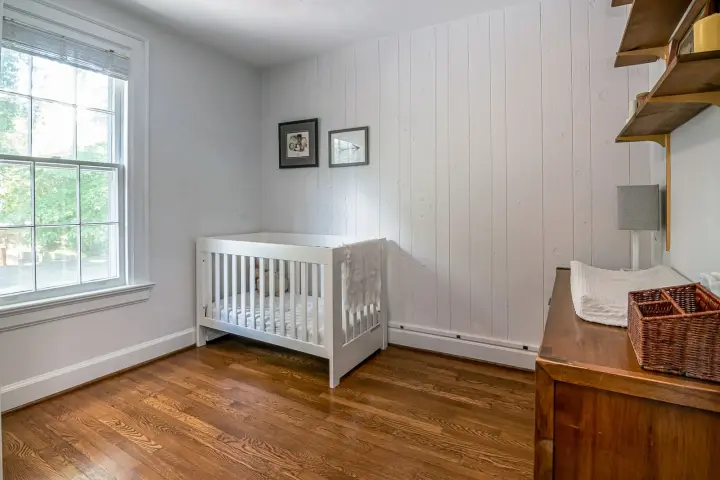
- Use a sturdy crib that meets current safety standards, with a firm mattress and no loose bedding. Ask your pediatrician about safe sleep.
- Keep toys age-appropriate and check small parts.
- Keep purses, bags and backpacks out of reach. They often hold medicines, coins and other hazards.
- Store firearms unloaded in a locked case, with ammunition locked in a separate place, as the AAP advises.
Medicines, Cleaners and Poisons
- Use safety locks on all cabinets with dangerous items. The AAP says to keep medications, alcohol, cleaning fluids and liquid nicotine out of reach, and not to rely only on child-resistant caps.
- Keep products in their original containers.
- Poison Control suggests keeping cleaning products in cabinets with child-resistant latches rather than low, unlocked cabinets.
- Save Poison Help (1-800-222-1222) in every phone and on the fridge. It is free, confidential and open 24 hours a day.
⚠️ Smoke and carbon monoxide alarms
The AAP says to install smoke and carbon monoxide alarms on every level of the home and outside bedrooms, and to check them monthly. Alarms are one of the most important safety devices in a home.
Baby-Proofing by Stage
Your child’s skills change fast, and so do the risks. This guide helps you stay one step ahead.
| Stage | New skills | Focus on |
|---|---|---|
| Newborn to 3 months | Lying on back, early rolling | Safe sleep space, never leave on high surfaces, hot drinks away from baby |
| 4 to 7 months | Rolling, sitting, grabbing | Small objects, cords, never leave baby on beds or couches |
| 7 to 12 months | Crawling, pulling up | Gates, outlet covers, furniture anchors, cabinet locks |
| 12 to 24 months | Walking, climbing | Window guards, drawer stops, bathroom locks, medicines up high |
| 2 to 3 years | Running, opening doors | Door locks, water safety, climbing hazards, cleaning products |
What to take from the table: there is no age at which you can stop paying attention. As each new skill appears, do a fresh crawl-through.
Baby-Proofing in a Rental or Small Space
You do not need to drill into every wall.
- Choose no-drill cabinet latches and adhesive drawer locks.
- Use pressure-mounted gates in places where a wall-mounted gate is not allowed, but never at the top of stairs. The AAP advises gates firmly mounted for stairs.
- Ask your landlord about anchoring. Anchoring furniture to a wall is a safety measure, and many landlords will allow small holes. Patch them when you move out.
- Rearrange furniture. Place heavy pieces in safe positions and keep climbable furniture away from windows.
- Use a playpen or play yard as a safe space for short periods, following the manufacturer’s instructions.
- Store hazards high. In a small home, use top shelves and closets with high latches.
Visiting Other Homes
Hazards do not stop at your front door.
- Do a quick crawl-through when you arrive at a new place.
- Ask hosts to move medicines and purses out of reach.
- Bring a few portable safety items, such as outlet covers or a portable gate if your child is mobile.
- Stay close near stairs, pools and kitchens.
- Share your emergency plan with caregivers, and give them your phone number.
A Weekend Baby-Proofing Plan
You do not have to do everything at once. Here is one way to spread it out.
| When | What to do | Time |
|---|---|---|
| Saturday morning | Crawl-through and make a list | 45 minutes |
| Saturday midday | Anchor furniture and TVs | 1 to 2 hours |
| Saturday afternoon | Lock cabinets with cleaners and medicines | 45 minutes |
| Sunday morning | Outlet covers, cord management, window cords | 1 hour |
| Sunday midday | Gates at stairs and kitchen, bathroom fixes | 1 to 2 hours |
| Sunday afternoon | Test alarms, save emergency numbers | 20 minutes |
What to take from the table: two focused half-days handle most of the big tasks. Spread it across a few weeks if you need to.
Safety devices help, but nothing replaces a watchful adult.
Tools That Can Help
These are examples. We did not test them for this article. The details come from the Amazon listings (checked October 4, 2026), and listings can change. Check that any device is installed correctly and fits your home. No product makes a home risk-free.
Pick 1 · No-drill cabinet and drawer strap locks
SKYLA HOMES Cabinet Strap Locks for Baby Proofing (8 pack, white)
May suit: Families with crawling babies or curious toddlers who want to keep cleaning products behind a closed, latched cabinet door.
A simple extra layer of protection. Why it works: a closed latch keeps curious hands off cleaners stored under the sink. Best for: kitchen and bathroom cabinets. Problem it solves: a low cabinet that opens with one tug.
- Adjustable 3 to 7 inch straps, per the listing
- No-drill adhesive installation; the listing says to let the adhesive bond for 24 hours
- Press-and-slide release for adults, per the listing
- Listing says they fit cabinets, drawers and some appliances
- Pack
- 8 locks, white
- Strap length
- Adjustable, 3 to 7 inches (per listing)
- Material
- Plastic latches and nylon straps (per listing)
- Install
- Adhesive, no drilling (per listing)
- Release
- Press-and-slide for adults (per listing)
- Brand
- SKYLA HOMES
Strengths
- No tools or drilling, so it is renter-friendly
- Flexible strap bends around corners
- Adults can open it with one hand once you learn it
Limitations
- Set the strap length before pressing it on, because it is not meant to be readjusted often
- Adhesive needs a clean, dry surface and time to bond
- No lock is childproof; keep products out of reach too
Affiliate link. As an Amazon Associate, we earn from qualifying purchases.
Pick 2 · Outlet covers for unused sockets
Safety 1st Electrical Outlet Covers (36 count)
May suit: Families with crawlers and toddlers who want to cover unused wall outlets.
A quick safety fix. Why it works: a cover blocks small fingers and objects from unused sockets. Best for: living rooms, bedrooms and hallways. Problem it solves: open outlets at toddler height.
- 36 covers in a value pack, per the listing
- Described as easy to remove and reusable, per the listing
- Intended to keep fingers and objects out of outlets, per the listing
- Count
- 36 covers
- Use
- Unused electrical outlets (per listing)
- Reusable
- Easy to remove and reuse (per listing)
- Brand
- Safety 1st
Strengths
- Enough covers for several rooms
- Inexpensive first layer of protection
- Easy to use
Limitations
- Choose covers that are too large to swallow, as pediatric guidance advises, and replace any that crack
- Adults must remember to put the covers back after unplugging
Buy from Amazon : Safety 1st Electrical Outlet Covers (36 count) (opens Amazon in a new tab)
Affiliate link. As an Amazon Associate, we earn from qualifying purchases.
Pick 3 · Metal anti-tip furniture anchors
Furniture Anchors, 10-Pack Anti-Tip Straps for Baby Proofing
May suit: Families with climbing toddlers who need to secure dressers, bookcases and TV stands to the wall.
A tip-over safeguard. Why it works: straps hold heavy furniture to the wall so a climbing child cannot pull it over. Best for: dressers, bookcases and TV stands. Problem it solves: furniture that tips when pulled.
- Ten anchors in a pack
- Listing says stainless steel wire straps and brackets
- All hardware included, per the listing
- Attaches to the back of the furniture and to the wall, per the listing
- Count
- 10 anchors
- Material
- Stainless steel (per listing)
- Includes
- Screws, steel wire straps, brackets and expansion nails (per listing)
- Use
- Dressers, bookcases, TV stands and other tall furniture
Strengths
- Enough anchors for a whole nursery or playroom
- Hardware is included
- Installation takes minutes, per the listing
Limitations
- You must attach them to studs or use anchors rated for your wall type
- Renters should check lease rules before drilling
Affiliate link. As an Amazon Associate, we earn from qualifying purchases.
8 Common Baby-Proofing Mistakes (and Easy Fixes)
❌ Mistake 1: Doing it all once and forgetting it
✅ Fix: Repeat the crawl-through every few months as your child grows.
❌ Mistake 2: Using accordion-style gates
✅ Fix: Choose gates firmly mounted to the studs.
❌ Mistake 3: Not anchoring furniture
✅ Fix: Anchor dressers, bookcases and TV stands to the wall.
❌ Mistake 4: Relying on child-resistant caps
✅ Fix: Lock medicines away and keep them up and out of sight.
❌ Mistake 5: Leaving window cords loose
✅ Fix: Use cordless coverings, or secure cords out of reach.
❌ Mistake 6: Forgetting low drawers
✅ Fix: Use latches on cabinets and drawers a child can reach.
❌ Mistake 7: Skipping alarms
✅ Fix: Install smoke and CO alarms on every level and test them monthly.
❌ Mistake 8: Thinking devices replace supervision
✅ Fix: Stay close, especially around water and stairs.
Why these fixes work: they follow AAP and CPSC guidance and focus on the highest-risk areas.
Pro Tips for Safer Homes
- Check other people’s homes. Grandparents’ houses and friends’ homes have their own hazards. Best for: visits.
- Ask visitors to keep bags up high. Best for: guests with medicines in purses.
- Write down emergency numbers. Post them where caregivers can see them. Best for: babysitters.
- Take a CPR class. Best for: peace of mind.
- Teach older children. Show them how to keep small parts away from babies. Best for: multi-age homes.
Real-Life Examples: Three Home Stories
These are illustrative examples based on common situations. They are not real customer reviews or quotes.
Example 1: The dresser anchor
A mom anchors a tall dresser after reading about tip-overs. Her climbing toddler tugs at the drawers a week later and the dresser stays put. What worked: anchoring before a problem.
Example 2: The purse
A dad notices his toddler heading for a guest’s purse and moves it onto a high hook. What worked: a quick scan of what is within reach.
Example 3: The window cord
A family switches to cordless blinds in the nursery. What worked: removing a hazard instead of managing it.
💡 The pattern
See it from their height, fix the big risks and revisit often.
Frequently Asked Questions
When should I start baby-proofing?
Before your baby starts rolling and crawling. Many parents start during pregnancy, then update as the child grows.
Do I need to anchor all my furniture?
The AAP suggests securing furniture, mirrors and TVs that could tip. Start with tall or heavy pieces in children’s rooms.
Are child-resistant caps enough for medicines?
No. The AAP says not to rely only on child-resistant caps. Lock medicines away or keep them up and out of sight.
What is the best type of safety gate for stairs?
The AAP says to avoid accordion-style gates and to use gates firmly mounted to the studs at the top and bottom of stairs.
How do I know which products are safe?
Look for devices that meet current safety standards and follow the installation instructions. The CPSC has childproofing guidance.
Who do I call if my child swallows something harmful?
Call Poison Help at 1-800-222-1222, or 911 if your child has trouble breathing or is unresponsive.
Your Baby-Proofing Checklist (and Final Thoughts)
- Do a crawl-through at your child’s height.
- Anchor furniture, mirrors and TVs to the wall.
- Install gates at the top and bottom of stairs.
- Cover unused outlets and manage cords.
- Use cordless window coverings or secure cords.
- Lock cabinets with medicines and cleaners.
- Set the water heater to no more than 120°F.
- Install and test smoke and carbon monoxide alarms.
🛒 Setting up a nursery or tracking baby’s milestones? Explore our essentials list.
Final thoughts
No home is perfectly safe, but you can make yours much safer with a few focused weekends and a habit of seeing the house from your child’s height. Fix the big things first, supervise closely and keep improving.
You are already doing the most important thing: paying attention. 💛
Affiliate note: some links in this article are Amazon affiliate links. If you buy through them, we may earn a small commission at no extra cost to you. See our Affiliate Disclosure. Product details were checked on Amazon.com on October 4, 2026 and may change.
Sources and further reading
- HealthyChildren.org (American Academy of Pediatrics) — Home Safety: Tips for Families With Young Children
- HealthyChildren.org (American Academy of Pediatrics) — Preventing Furniture and TV Tip-Overs
- HealthyChildren.org (American Academy of Pediatrics) — Make Baby's Room Safe: Parent Checklist
- U.S. Consumer Product Safety Commission — Childproofing Your Home
- HealthyChildren.org (American Academy of Pediatrics) — 5 Bathroom Safety Tips for Infants & Young Children
- Poison Control (America's Poison Centers) — Top Tips for a Safe Spring Cleaning
This article is general information, not medical advice. It does not replace guidance from your doctor, midwife, pediatrician or other qualified professional. Read our health information disclaimer.