Some kids finish a plate of food in five minutes flat. Then they ask for more, or for dessert, or they are up and running before anyone else has sat down. If this sounds like your house, you may have wondered whether it matters how fast kids eat. The research suggests it may, and the habits that help are simple, calm and free.
⚡ The short answer
Studies link faster eating in children to a higher body mass index, a larger waist and some less favorable blood fat levels, and slower eating gives the body more time to feel full. But these studies show associations, not proof that speed causes the differences, and researchers say more careful studies are needed.
The good news is that the habits that slow kids down, such as family meals without screens, small bites and relaxed conversation, are healthy for other reasons too.
This guide is for parents of toddlers, school-age children and teens. You will learn what the research says and does not say, why fullness takes time, how to help a fast eater slow down without turning meals into battles, and what to do about rushed school lunches. We will end with mistakes, tips and a checklist. 🍽️
This is general information, not medical advice. If you are worried about your child’s weight, growth, appetite, choking or eating habits, talk to your pediatrician.
Why Eating Speed Matters
Your body does not feel full the moment your stomach is full. It takes time for signals to travel between the gut and the brain. When you eat slowly, those signals have time to arrive, and you can notice when you have had enough. When you eat very fast, you can pass the point of comfortable fullness before your body has had a chance to say so.
A review of the research on children’s eating notes that slowing the rate of eating allows more time for satiety processes and lengthens the satiety curve, which can reduce the total energy eaten. In plain English: slow eaters tend to feel full on less food.
Children are still learning to read these signals. Toddlers are naturally good at stopping when they are full, but busy schedules, screens and pressure to clean the plate can teach them to ignore their bodies. Teaching slower eating is partly about protecting that natural skill.
💡 Fullness is a message that arrives late
Think of fullness like a text message that takes a while to deliver. If you keep eating, you may send yourself a second plate before the first message arrives.
What the Research Actually Says
It is worth being specific, because this topic is often oversold. Here is what two sets of studies report.
| Finding | What it suggests | Important limit |
|---|---|---|
| A study of eating speed and cardiometabolic risk factors in children found that those who reported eating faster had a higher BMI, a larger waist, higher triglycerides and total cholesterol, and lower HDL than those who reported a normal or slow eating speed | Eating speed is linked with several health markers | This kind of study shows an association, and cannot prove that fast eating causes the differences |
| An exploratory study found that children eat school lunch very quickly, which may affect how much they eat | Short lunch times may push kids to eat fast | It was small and exploratory |
| Researchers describe a “satiety unresponsiveness” when eating very fast, with a weaker gut-hormone response than moderate-speed eating | Fast eating may dull the body’s fullness signals | More research is needed in children |
| The authors of the cardiometabolic study say slowing eating may be a target for prevention, but that carefully designed longitudinal and intervention studies are needed to establish causality | Slowing down is a reasonable, low-risk habit to try | The size of any benefit is not yet proven |
What to take from the table: there is a consistent pattern, but it is not a guarantee. Eating slowly is a gentle, healthy habit with little downside, and it fits with everything else pediatric groups recommend, like family meals and calm mealtimes.
Slow eating is a habit worth building. It is not a magic switch, and it is never a reason to shame a child.
What Counts as “Slow Enough”?
There is no official number of minutes for a child’s meal. A toddler might sit for 15 to 20 minutes. A school-age child might take longer. What matters more than the clock is whether your child is chewing, pausing, talking and noticing how they feel.
Here are signs that a child is eating at a comfortable pace:
- They chew food before reaching for the next bite.
- They pause during the meal to talk, drink water or look around.
- They can tell you when they are full, or they start playing with their food.
- They do not seem to be in a hurry to leave the table.
And here are signs that a child may be eating too fast:
- They stuff in several bites before swallowing.
- They finish well before everyone else and ask for seconds right away.
- They say they are hungry soon after eating a large meal.
- They gulp drinks with food.
🩺 Safety note about speed
Eating too fast can also raise the risk of choking, especially in young children. Always supervise meals, cut food into pieces that are safe for your child’s age, and ask your pediatrician which foods to avoid. If your child chokes or gags often, talk to a doctor.
Why Family Meals Help
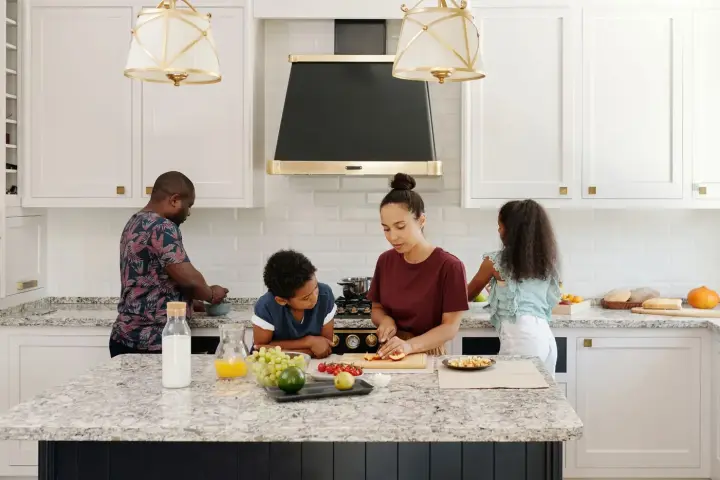
The American Academy of Pediatrics lists sharing a meal together as a family, as often as you can and without media distractions, as its first tip for parents of picky eaters. The reason is simple: kids copy what they see. If everyone at the table is chewing, talking and putting a fork down between bites, that is what your child will learn.
A relaxed family meal also gives your child something to do other than eat. They can answer a question, tell a story or help pass the bowls. Those pauses naturally slow the meal.
Family meals do not need to be fancy or daily. Even three or four times a week, with a simple dinner and screens off, makes a difference. And if dinner is too hectic, try a family breakfast or a weekend lunch.
10 Gentle Ways to Help Kids Slow Down
- Sit down together. Start meals at the table, with everyone seated. Standing and walking while eating speeds things up.
- Turn off screens. Phones, tablets and TV pull attention away from fullness and from the people around you.
- Serve small portions. Smaller plates feel more manageable, and kids can ask for more.
- Use a child-sized spoon or fork. Smaller bites mean slower eating and fewer chances of choking.
- Model it yourself. Chew, pause and talk. Kids notice what you do more than what you say.
- Put the fork down between bites. Make it a game: “Fork down, take a sip.”
- Ask questions. “What was the best part of your day?” fills pauses with conversation.
- Offer water with the meal. Sipping water gives a natural pause. Offer milk with or after the meal rather than before.
- Use a visual timer. A five-minute sand timer gives older kids something to watch and a goal to reach.
- Notice fullness together. Ask, “Is your tummy still hungry, or getting full?” without pressure to finish.
Why this works: every step either adds a natural pause, shrinks the bite or draws attention to how the body feels. None of them require nagging.
Conversation Starters for Slower Dinners
Talk is the best brake on a fast meal. Keep a few questions ready.
| Age | Try asking | Why it works |
|---|---|---|
| Toddlers | “What color is your food?” “Can you find something round?” | Simple, playful and sensory |
| Preschoolers | “What was the funniest thing today?” “Who did you play with?” | Invites short stories |
| School-age kids | “What is one thing you learned?” “Would you rather…?” | Sparks fun debate |
| Teens | “What is something coming up that you are looking forward to?” | Opens up the day without a lecture |
| Whole family | “Rose, thorn, bud”: a good thing, a hard thing, something to look forward to | Gives everyone a turn |
Rushed School Lunches
Some fast eating is not a choice. The researchers who studied children at school found that lunch periods can be short, and that kids may rush through food to make time for recess. If your child tells you they have only a few minutes to eat, you have a few options.
- Ask the school about lunch length. Parent groups sometimes successfully advocate for more time.
- Pack foods that are easy to eat. Cut fruit, small sandwiches and cheese cubes help kids eat quickly without choking.
- Pack small portions. A reasonable amount can be finished in the time available.
- Make a calm after-school snack and dinner. That way your child does not have to rely on a rushed lunch alone.
- Talk to your child. Ask how lunch goes, who they sit with and whether they feel rushed.
Teens and Eating Speed
Teenagers are often in a hurry. Early classes, practice, homework and phones all compete with meals. Lecturing rarely works at this age, but a few small things can help.
- Keep one regular family meal. Pick the day that works for everyone, even if it is a weekend breakfast.
- Make the table a no-phone zone for everyone. Adults go first. Teens notice fairness.
- Let them cook. A teen who has helped make dinner tends to sit and enjoy it.
- Keep conversation light. Ask about music, sports or a funny video, not about grades or weight.
Teens also notice stress. If a teen seems anxious about food, eats in secret or avoids meals, talk to your pediatrician rather than trying to fix it at the table.
What Not to Do
Slow-eating habits are positive, but some approaches backfire.
- Do not scold or shame a child for eating fast. It can make meals stressful and make a child anxious about eating.
- Do not force a clean plate. Pressure to finish can teach children to ignore fullness, which is the opposite of the goal.
- Do not use food as a reward or a bribe. The AAP warns that bribes can make treats seem more desirable and lead to dinner-table conflict.
- Do not make weight a topic at the table. Speak to your pediatrician privately if you are concerned.
Helpful Tools for Slower, Calmer Meals
These products are examples, and we did not test them. The details come from their Amazon listings (checked October 4, 2026), and listings can change. A tool does not replace a calm routine.
Pick 1 · A visual pause for older kids
Hourglass Sand Timer, 5 Minutes, with protective cover
May suit: Families who want a visual cue for a calm, unhurried meal.
A gentle way to pace a meal. Why it works: a visual timer gives children something to watch instead of a clock to race. Best for: older kids learning to pause between bites. Problem it solves: meals that are over in three minutes.
- Counts about 5 minutes; listing says to allow roughly a 10 percent time deviation
- Listing says a double-protection design with a protective outer tube
- Made of glass with a protective cover, per the listing
- Marketed as safe for kids, per the listing
- Time
- About 5 minutes (listing notes up to 10 percent deviation)
- Design
- Glass hourglass with protective cover (per listing)
- Use
- A visual timer for slow meals and quiet time
- Note
- Not a precise clock, per the listing
Strengths
- Silent and screen-free
- Kids can watch the sand and slow down
- Cheap and simple
Limitations
- Not an accurate timer, per the listing
- Glass inside the cover means it should stay out of toddler hands
Buy from Amazon : Hourglass Sand Timer, 5 Minutes, with protective cover (opens Amazon in a new tab)
Affiliate link. As an Amazon Associate, we earn from qualifying purchases.
Pick 2 · Smaller bites for toddlers
Munchkin Raise Toddler Fork and Spoon Set, BPA Free (6 pack)
May suit: Parents of toddlers who are learning to feed themselves.
A simple set for little hands. Why it works: utensils sized for toddlers make self-feeding easier and less frustrating. Best for: toddlers practicing with a fork and spoon. Problem it solves: adult-size utensils that are too big and awkward.
- Six utensils: three forks and three spoons
- Raised base keeps the tips off tables, per the listing
- Ergonomic shape for little hands, per the listing
- Listing says BPA free
- Count
- 3 forks and 3 spoons
- Design
- Raised base keeps utensil tips off surfaces (per listing)
- Material note
- BPA free (per listing)
- Made for
- Toddlers practicing self-feeding
- Brand
- Munchkin
Strengths
- Small, toddler-friendly size
- Raised base helps with mealtime mess
- Six pieces means spares for the diaper bag
Limitations
- Toddlers may still prefer fingers, which is normal
- Always supervise young children while they eat
Affiliate link. As an Amazon Associate, we earn from qualifying purchases.
Pick 3 · Pre-portioned lunches
Bentgo Kids Bento-Style 5-Compartment Leak-Proof Lunch Box
May suit: Parents who pack school or daycare lunches and want small, separate sections for fruit, vegetables, protein and a snack.
A practical lunch box for variety. Why it works: five little compartments invite you to pack small amounts of several foods, which is a gentle way to offer new things. Best for: school lunches, picnics and snack plates. Problem it solves: soggy, mixed-up lunches and the “I don’t like foods that touch” problem.
- Five compartments to keep foods separate
- Listing says a leak-proof lid and latches kids can open
- Removable tray is freezer safe, microwave safe and top-rack dishwasher safe, per the listing
- Listing says BPA free, with a capacity of 2.4 cups
- Compartments
- 5
- Capacity
- 2.4 cups (per listing)
- Material features
- BPA free, dishwasher safe (per listing)
- Tray care
- Freezer, microwave and top-rack dishwasher safe (per listing)
- Lid
- Leak-proof with latches (per listing)
- Brand
- Bentgo
Strengths
- Small sections make variety easy: a bit of each food group
- Helps keep foods from touching, which some picky eaters prefer
- Easy to wash
Limitations
- Compartments are small, so it fits snack-size portions better than big meals
- Check the brand's care notes for what can go in the microwave
Affiliate link. As an Amazon Associate, we earn from qualifying purchases.
7 Common Mistakes (and Easy Fixes)
❌ Mistake 1: Scolding fast eaters
✅ Fix: Stay neutral. Praise the pauses and the conversation.
❌ Mistake 2: Eating in front of a screen
✅ Fix: Turn it off. Eat at the table.
❌ Mistake 3: Piling on large portions
✅ Fix: Serve small amounts, and let kids ask for more.
❌ Mistake 4: Insisting on a clean plate
✅ Fix: Let kids stop when they are full.
❌ Mistake 5: Rushing the meal yourself
✅ Fix: Slow down and model it.
❌ Mistake 6: Ignoring choking safety
✅ Fix: Cut food to a safe size, supervise and ask your pediatrician.
❌ Mistake 7: Treating speed as the only issue
✅ Fix: Keep an eye on the whole picture: variety, routine, family time.
Why these fixes work: each one lowers pressure while adding a natural pause. The result is a calmer meal that happens to be slower.
Pro Tips for Calmer Mealtimes
- Start the meal with a sip of water. Best for: kids who dive in.
- Serve food in courses. Offer vegetables first, then the rest. Best for: picky eaters and fast eaters alike.
- Pause the meal midway. Ask each person for a “highlight.” Best for: families with chatty kids.
- Keep portions small and refill. Best for: kids who finish quickly and want more.
- Make meals pleasant. Use a candle, music or a tablecloth. Best for: turning dinner into an event.
Slow, calm meals are a gift you give your child and yourself.
Real-Life Examples: Three Slow-Eating Stories
These are illustrative examples based on common situations. They are not real customer reviews or quotes.
Example 1: The five-minute dinner
A dad notices his seven-year-old finishes dinner in five minutes. They start a “fork down” game and ask a question at each course. What changed: meals now take twenty minutes, and the child says he feels full sooner.
Example 2: The screen at dinner
A mom lets her daughter watch a show at dinner, and she does not notice when she is full. What changed: the family turns screens off, and her daughter starts to say, “My tummy is done.”
Example 3: The school lunch rush
A grandmother learns her grandson has only ten minutes for lunch, and he eats too fast to enjoy it. What changed: his parents talk to the school and pack easy-to-eat foods so he can finish.
💡 The pattern
Success came from calm routines, not from rules or pressure. Fewer distractions and more conversation slowed each meal naturally.
Frequently Asked Questions
Does eating fast make kids gain weight?
Studies find that children who eat faster tend to have a higher BMI and other health markers, but they show an association and cannot prove that speed is the cause. Researchers say more studies are needed.
How long should a meal take for a child?
There is no fixed time. Look for chewing, pauses and conversation instead of watching the clock.
Is it okay to tell my child to slow down?
Gentle reminders are fine. Avoid scolding or shaming, which can make meals stressful.
Do screens affect how fast kids eat?
Screens can pull attention from fullness. Pediatric groups recommend meals without media distractions.
What can I do about a short school lunch?
Ask the school about lunch length, pack easy-to-eat foods in small portions and talk with your child about how lunch goes.
Should I talk to the doctor about my child’s eating speed?
If you are worried about weight, growth, choking or appetite, talk to your pediatrician.
Your Slow-Eating Checklist (and Final Thoughts)
- Eat together at the table whenever you can.
- Turn off screens during meals.
- Serve small portions and let kids ask for more.
- Use child-size utensils.
- Put forks down between bites.
- Fill pauses with conversation.
- Never force a clean plate or shame a fast eater.
- Cut food to a safe size and supervise meals.
🛒 Want a few helpers for calmer meals? See the picks below.
Final thoughts
Teaching kids to eat slowly is one of the simplest habits you can build. It gives fullness signals time to arrive, it makes mealtimes more social, and it lowers stress for everyone. The research is still growing, but the habits are healthy either way.
Start with one change this week, like turning off the screen or adding a conversation question. Small, steady steps can turn a five-minute dinner into a family moment. 💚
Affiliate note: some links in this article are Amazon affiliate links. If you buy through them, we may earn a small commission at no extra cost to you. See our Affiliate Disclosure. Product details were checked on Amazon.com on October 4, 2026 and may change.
Sources and further reading
- Eating Speed and Its Associations with Cardiometabolic Risk Factors in Children (PMC)
- Children eat their school lunch too quickly: an exploratory study of the effect on food intake (PMC)
- HealthyChildren.org (American Academy of Pediatrics) — 10 Tips for Parents of Picky Eaters
- KidsHealth — Toddlers at the Table: Avoiding Power Struggles
This article is general information, not medical advice. It does not replace guidance from your doctor, midwife, pediatrician or other qualified professional. Read our health information disclaimer.